
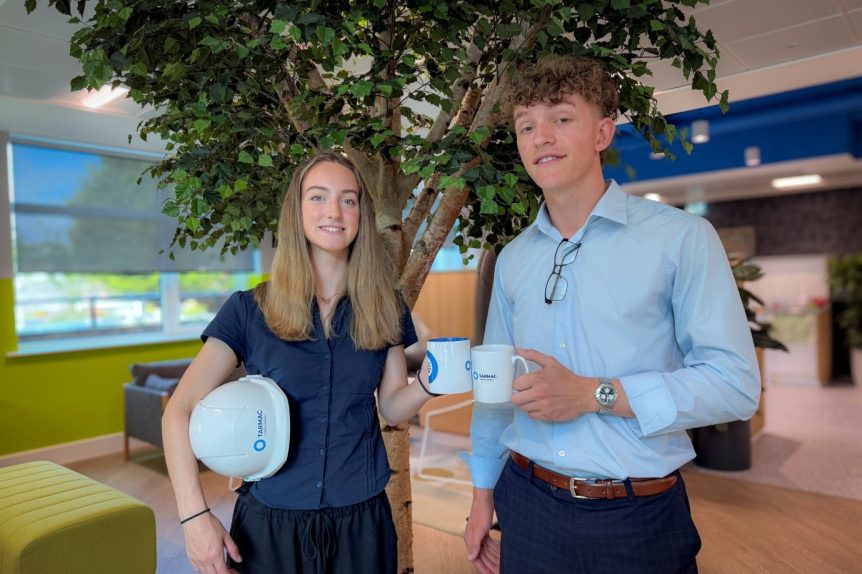
Our names are Sammy Hindle and Jess Barker and we’re taking part in work experience with Tarmac this week to get an understanding of the company and construction industry as a whole.
When thinking of any construction industry, the idea of its environmental impact immediately comes to mind. And, as we’re entering the workplace with an outside perspective, we asked to conduct an interview with a member of Tarmac’s sustainability team to gain an insight into what the company is doing to reduce its carbon footprint.
In our effort to understand more about tarmac’s sustainability goals, we interviewed a member of their sustainability team, Amall Saleh.
Could you give us an overview of what you do here at Tarmac?
My name is Amall and I’m a sustainable construction advisor. My main role is that I look at the carbon emissions of our products that we generate on site: some of the materials that we make or some of the materials that we excavate from our quarries. Calculating carbon supports a lot of our teams, some teams win work based on the carbon emissions we provide.
Have you seen any changes or improvements in the sustainability of Tarmac since you have been working here?
I’m in the middle of looking at EPD’s, environmental product declarations, which is like a carbon footprint for our products which will last five years. There has been an increase in demand. When I started, we had only done 1,500 in the first year, but in the following year, it grew to 5,000. We are looking at new processes to make it a lot faster, and therefore easier to acquire sustainability information.
Would you say there are any parts in the process of creating a sustainable product that the public may not be aware of?
Yes, using a warm mix instead of a hot mix is something that the public are probably not aware of. Also, we decrease our emissions using RAP, so that’s recycled asphalt. They basically dig up old asphalt, process it and then put that back into our mixes. We also take slag which is a waste product from the steelworks and put it into our concrete which decreases the amount of cement we have to produce. So, there’s loads of different technical things that we do that most people wouldn’t know about.
What would you say is one of the most exciting projects you’ve done for Tarmac?
We’ve recently revamped of asphalt calculations spreadsheet which is soon to be completed just needs a few more tweaks. But hopefully once its complete it will completely streamline our asphalt calculation process and then we can hopefully do the same for concrete calculations too.
What would you say are your ambitions for the future sustainability of Tarmac?
If we can streamline a lot of our processes not just in carbon footprinting, but also the processes on site, and how we record things, this would have a huge impact. This is because we are always dealing with data collection and looking at different platforms to collect data. I think if we were able to spend less time on data collection and more time to look at the data to know where to put all our focus into, and we will be able to look at the more ways to make Tarmac more sustainable.
Overall, from our interview Amall we concluded that Tarmac’s sustainability team are actively making effort to help reduce carbon emissions through processes like recycling and material innovation. Amall was enthusiastic about her work in Environmental Product Declarations and seemed confident of the future of Tarmac’s sustainability as well as continued efforts to keep our planet a clean and safe place for future generations.
