
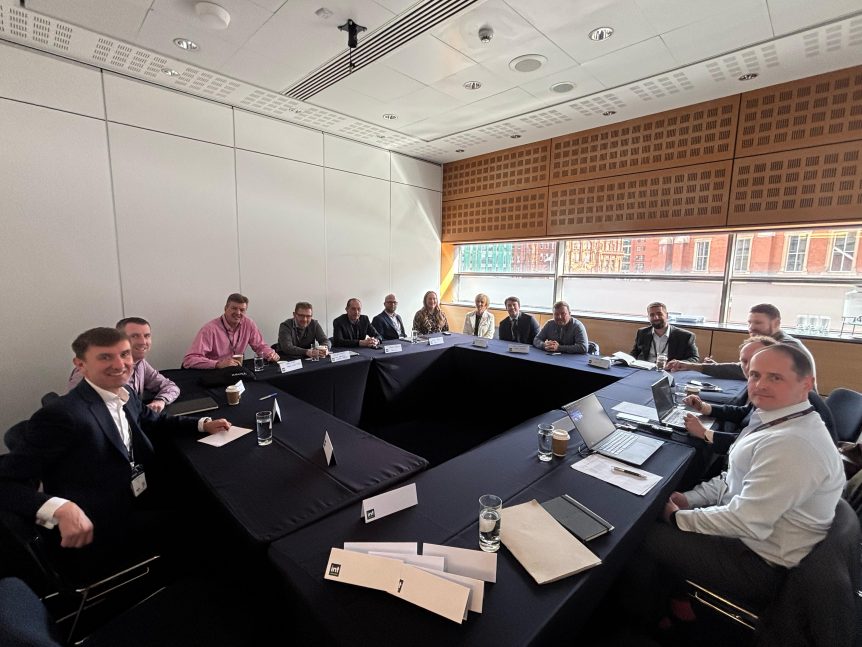
At Interchange 25, Tarmac brought together local authorities, materials providers, consultants and contractors to explore how in a changing climate and with increasing urban growth, road infrastructure and stormwater systems must tackle run off to prevent failures, reduce pollution and mitigate environmental impact.
An environmental challenge – managing highway run off
Participants highlighted the environmental impact of highways run off, which remains a significant challenge for network operators and local authorities. One attendee commented that managing the impact is likely to be one of the most important areas of intervention in the RIS3 roads investment period (from 2025 to 2030).
Hydrocarbons from cars and tyre degradation are contributing factors to run off pollution and toxicity. However, some attendees felt that the transition to EVs would in time reduce the former.
Attendees reported that work is underway to develop a strategy to tackle the 22,000 outfalls that occur across the strategic road network. This is about developing carriageway solutions and using nature-based techniques offsite. While the issue of run off has worked its way up the risk register for clients, the highways industry is waiting to understand whether funding will be available through RIS3 to tackle the issue.
One local authority’s response
Attendees heard from Waltham Forest Council, an authority which, after several major incidents, has become a lead flood authority with a preventative approach to mitigating the impact of flooding. The authority highlighted the flooding issues that it has tackled in a changing climate in London and the impact of urban growth.
The London borough has put in place a long term strategy with permeable paving and the type of solutions typically used on green field sites as well as tanks within carriageways, as part of a comprehensive package of measures.
For the attending council officer, stakeholder management with a variety of organisations as well as securing political will are key elements of being able to embed greater climate resilience into the network.
There was discussion from some attendees about the need for local authorities to act but also an understanding from all of the fiscal challenges that they face in tackling water run off and maintaining the asset.
Attendees noted that in the same way that a ‘sticking plaster’ is put on a pothole, similar short term solutions were often used by councils for these issues and that there was a need to increase budgets and consider longer term treatments.
One attendee noted that towns such as Mansfield had successfully secured significant funding support from water companies and that these projects provided important opportunities and a blueprint for other locations.
Back to the future – future-proofing streets
Peter Hyde, managing director at Riney highlighted the new to future-proof streets. “Over 25 years ago I was working on projects that would involve putting pipework in streets. Yet over the last decade, these types of schemes have not been delivered despite a changing climate. The fiscal environment has ultimately changed what is being considered in many areas but we have to return to embedding solutions that will deliver long term resilience.”
Beyond the constraints of who pays for these type of schemes, some attendees highlighted the practical challenges of delivering preventative projects in communities that have not experienced flooding. Securing community buy-in during a period of disruption remains a key challenge.
One participant noted that the Environment Agency will shortly be publicising new flood maps which will be a significant milestone because these may highlight locations that have not experienced flooding before.
It was felt that this might also make it easier to have conversations with local communities about the retrofit solutions needed in their locality, but it was agreed that early engagement and local consultation was critical. There was acknowledgement that sometimes a big challenge faced is installing a solution in a location that has not previously experienced the devasting impact of floods.
Water quality and the funding elephant in the room
For some attendees, the high profile nature and socio-economic impact of dealing with floods has put water management on the radar. Phil Collins, sales director at Hydro International said: “It’s vital that the impact of flooding is high on the political agenda, but it has meant that there is now an insufficient focus on managing water quality. Getting water quality and the issue of water run off on the highways network to a level where it is being understood and tackled by network decision makers is now a priority.”
While there potentially may be future funding on the strategic network for dealing with run off, the challenge will be how local authorities can be financially supported at a time when budgets are highly constrained.
Some attendees cited the importance of metro mayors, devolution deals and the creation of new combined authorities as important to ensuring that politicians understood the nature and importance of water management to support housing growth and improved infrastructure.
With thanks to the following participants at the roundtable discussion: Declan Lynch from Waltham Forest Council, Peter Hyde from Riney and Tarmac Kier JV, Pete Tamblin from Marshalls, Mike Rayyan from Zest, Phil Collins from Hydro International, Jo Bradley from Stormwater Shepherds, Dan Jarman from Hydro International, Daniel Jackson from CRH, David Symons from WSP, Mark Goslin from Tarmac, Tom Guy from Gardiner & Theobald, Sven Till from AE Yates, Tony Carney from Huyton Asphalt Civils, James Blennerhassett from Huyton Asphalt, and Liam Hare from Tarmac.
