
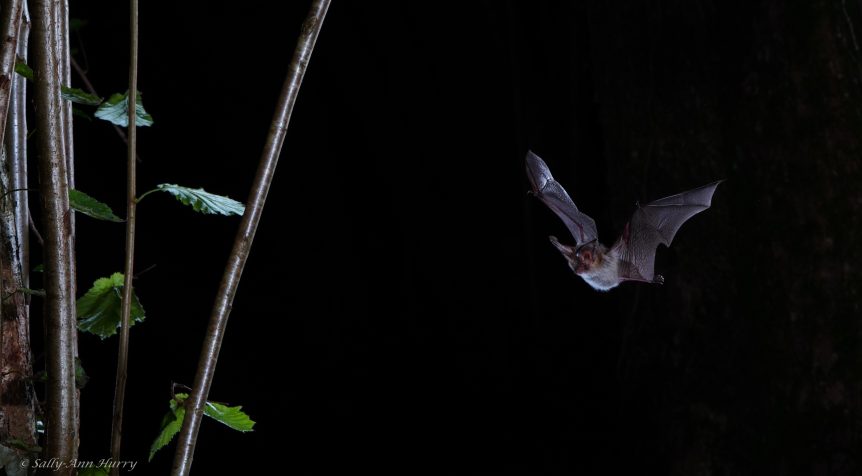
The grey long-eared bat is one of the rarest bat species in the UK, thought to be down to as little as 1,000 individuals. On top of that, it has quite a limited range and is mostly restricted to southern England. This new record in north Kent is an exciting new find!
Commissioned by Tarmac, the UK’s leading sustainable construction solutions business, Ecologist Sally-Ann Hurry from Mountfield Ecology carried out a bat assessment of a property near Rochester in Kent. The results of this assessment would inform how bats needed to be considered in the proposed maintenance and repair work.
During the building inspection, a small number of bat droppings were found within the roof void. Sally-Ann collected a sample of the most recent droppings and submitted them to Ecotype Genetics for DNA sequencing, which would confirm to which bat species they belonged to.
The results came in and they were identified as belonging to the rare grey long-eared bat. To be certain of this result, the sample was re-tested and the results came back the same. The bat droppings in this Rochester property were definitely from a grey long-eared bat. This species is currently listed as Endangered in the IUCN Red List for British Mammals.
The number of droppings and their location suggests that an individual bat has visited the roof void recently. However, more survey work is ongoing to fully understand how it uses the roost.
Why is this find so important?
The Red List for British Mammals shows that four of the 11 British mammal species which are red listed as being at risk of national extinction are bats. One of those four species is the grey long-eared bat. The species is one of two long-eared bat species in the UK. Its ‘cousin’, the brown long-eared bat is widespread, but the grey is mainly confined to the south/southwest of England.
The grey long-eared bat prefers to hunt over large open spaces like grasslands, and it needs to roost in large, open roof spaces. However, the species also relies on woodlands and hedgerows which they use as safe commuting routes.
Changes in agriculture practices have destroyed much of these habitats and led to a decline in its favourite insects, which have contributed to the decline of the grey.
Sally-Ann Hurry, Ecologist at Mountfield Ecology said: ‘The identification of a grey long-eared bat roost in north Kent has been surprising while considering the species known distribution and range being mainly associated with the south coast of England. Furthermore, north Kent has not been identified during former habitat mapping and research as being an area likely to become suitable for the species.’.
With as few as 1000 individuals left in the UK, and only nine known maternity colonies, the grey long-eared bat is one of our rarest mammals. A new roost in Kent brings hope that the species could be expanding its range.
What the future holds for the grey long-eared bat
Tarmac will continue to work with Mountfield Ecology to ensure the identified roost is safeguarded while the necessary building works are undertaken. Additional bat conservation efforts will be made in the immediate locality to maximise the chances of survival for the grey long-eared bat.
Tarmac has recently become an affiliate member of new North Kent Woods and Downs National Nature Reserve which will provide opportunities to work with neighbouring landowners on landscape scale initiatives to enhance habitat for this species. Tarmac and Mountfield Ecology were pleased to share this new find with the wider bat conservation community. Together, they hope this will inform other ecologists and bat workers across Kent and ensure any roosts of this rare species are identified. This knowledge sharing will help to inform conservation efforts for the species and the future of the grey long-eared bat.
Image: Brown long-eared bat in flight. This is the more widespread of the two Long-eared bat species in the UK (Credit: Sally-Ann Hurry).
