
By Steve Birch, Circularity Director, Tarmac
At Tarmac, circularity isn’t a concept, it’s a commitment. Every mile of road we maintain, repair, or build presents an opportunity to do things smarter, cleaner, and more sustainably. One of the best examples of this in action is our use of Recycled Asphalt Planings (RAP).
RAP isn’t just a by-product of resurfacing works; it’s a breakthrough material. Every year, Tarmac reuses over one million tonnes of RAP across the UK. That’s a million tonnes of previously used material given a second life, cutting carbon emissions, preserving valuable natural resources, and reducing waste sent to landfill.
We call it the virtual quarry because that’s exactly what the road network becomes. By reclaiming what’s already in the ground, we avoid the need to extract fresh aggregates, reducing our environmental impact at every stage of the process.
Closing the loop with innovation
Our ambition is simple: to close the loop in road construction. We’re continuing to develop cutting-edge technology, like cold paving techniques and bitumen solutions that allow us to reuse asphalt planings without energy-intensive reheating. This not only saves carbon, but also supports faster, lower-cost road delivery.
At present, our average RAP addition rate sits around 30%, but we’re actively working to increase that. With the right advancements in our asphalt plant infrastructure, there’s no reason we can’t reach 70% or more by 2030. In fact, in Ireland, new asphalt plants within the CRH Group have already achieved 90% RAP addition rates, a benchmark we’re aiming to replicate here in the UK.
Smarter assets, more sustainable roads
Reaching those higher reuse rates isn’t just about intention, it’s about innovation. And, we’re building plants that are future-ready, designed to accommodate higher RAP contents and maximise circularity from day one.
We’re also working with our colleagues across CRH to share best practices and scale successful trials across the business. It’s about aligning our local ambition with global progress.
Driving technical progress with National Road Planing (NRP)
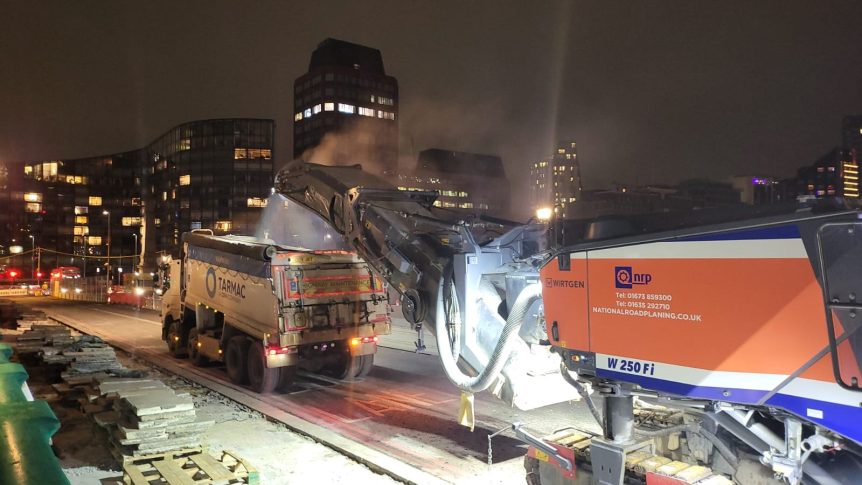
The engine behind much of this progress is our National Road Planing (NRP) business, which plays a critical role in making circularity viable and scalable. NRP is at the forefront of identifying, recovering, and supplying quality RAP materials with minimal environmental impact.
We’re trialling and adopting low-carbon innovations, such as electric planing machines and direct return logistics, taking recovered material straight back to asphalt plants for immediate reuse. This reduces haulage emissions and further enhances efficiency across the supply chain.
But it’s not just about volume, it’s also about value. NRP supports segregation of RAP based on the quality and performance characteristics of the original aggregate. For instance, high quality materials from surface layers can be selectively harvested and reused where skid resistance is critical. Lower-grade planings, meanwhile, are best suited for base and binder courses.
This selective harvesting, essentially “mining” the road network, has already been implemented successfully. The next step is wider adoption of these efforts, working with partners across the industry to build in longer planing windows and optimise roadworks for material recovery, not just resurfacing.
Paving the way to a circular economy
Circularity in road construction isn’t a future ambition, it’s already happening. RAP is the proof. It shows that we can build and maintain the infrastructure our society depends on while reducing waste, conserving materials, and cutting carbon.
By treating roads not just as assets but as resource banks, we’re unlocking a smarter way forward, one where infrastructure doesn’t just connect people, but helps protect the planet too.
