Low carbon fibre reinforced concrete for busy bus station
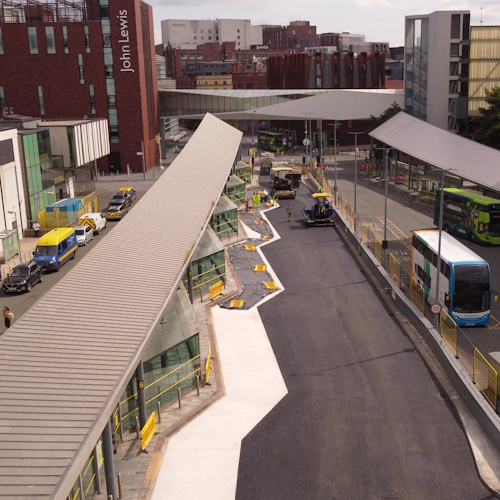
Liverpool One Bus Station, Liverpool
Client
Merseytravel/Liverpool City Council
Contractor
Huyton - HA Civils
Location type
City Centre Bus Station
Completion
September 2024
The challenge
Liverpool One is a major mixed retail, leisure and office development on the site of the old Liverpool Docks, completed to coincide with Liverpool’s year as European Capital of Culture in 2008. Huyton Asphalt Civils was appointed main contractor for a major project to regenerate the nearby Liverpool One Bus Station. The project aimed to increase the capacity of the bus station and prepare it to meet the city’s future sustainable transport needs as part of the Liverpool City Region Combined Authority’s Local Transport Plan. Delivering long term sustainability and minimising net carbon emissions were key aims of this project from the start, together with producing a durable, low maintenance infrastructure hub that would deliver 365, 24-7 service to Liverpool’s public transport users. Since Huyton Asphalt Civils are PAS2080 accredited, they would be able to accurately measure and record any carbon emissions associated with this project.
Our solution
The project involved constructing new parking bays for the buses that would use the station. The new bays would need to deliver long lasting resistance to the high static loading from the buses, including the new electric buses planned for the route. Tarmac’s TOPFORCE fibre reinforced concrete was recommended as an alternative to conventional steel mesh reinforcement. TOPFORCE fibre reinforced concrete improves the durability and crack resistance of concrete surfaces. It is quicker and easier to place than traditional mesh reinforced concrete as there is no need for the steel mesh reinforcement to be delivered or stored on site, which helps to reduce carbon emissions from vehicle emissions and improve site safety. With the large volumes of concrete required for this project, there were concerns raised over the potential impact on the overall carbon footprint. Following the completion of a project Carbon Reduction Plan by Huyton Asphalt Civils during the preconstruction phase of the project they decided to use a CEVO low carbon concrete mix to help reduce net emissions.
Results and benefits
As planned, 250m3 of TOPFORCE CEVO fibre reinforced concrete was supplied to the site and expertly placed by the team at Huyton Asphalt Civils. Using a TOPFORCE CEVO fibre reinforced low carbon mix delivered a significant reduction in carbon savings, almost halving the carbon footprint per cubic metre of the concrete supplied and saving over 49,500 kgCO2e for the entire scheme. When combined with low carbon asphalt this contributed to an overall net carbon saving for the scheme of 40% versus traditional construction methods. The fibre reinforced concrete enhanced the structural performance, durability and crack resistance of the concrete parking bays. It also helped to improve the speed and efficiency of the construction process while reducing delivery vehicle emissions and storage requirements on this busy city centre site. This in turn reduced the net carbon emissions for the project but also the wider impact on local residents and businesses.
Low carbon concrete solutions
What is CEVO?
CEVO represents Tarmac’s commitment to supplying materials that offer transparent carbon savings and easy to understand performance grading based on the amount of carbon taken out of the design using alternative binders, cement replacements, limestone fillers or an alkali activated solution. We align our current range of CEVO, low carbon concretes and screeds, to ratings published by the ICE, endorsed by the Green Construction Board in the Low Carbon Concrete Routemap. It uses intuitive A, B, C to G gradings similar to efficiency bars that we see on everyday electrical items in our daily lives. This enables architects, structural engineers, contractors and their clients to clearly measure and compare the carbon emissions associated with different materials, helping with decision making.
CEVO in practice
After working with the contractors to understand the specifications, strength requirements and programmed timescales for the project, Tarmac’s team are able to recommend optimised mix designs with major reductions in embodied carbon. This is supported with detailed cradle to gate carbon footprint calculations and sample testing to make sure that the data was in place to support these recommendations.
Working together
The client was delighted with the finished result and the speed of delivery: “HA Civils once again tapped into our innovative approach during delivery of the Bus Station Upgrade project for the benefit of one of our key clients, Merseytravel, by collaborating with Tarmac to implement the first use of their CEVO low carbon concrete in a fibre reinforced mix. The introduction of this material has reduced carbon emissions by 49.1% and represents yet another milestone in our continued sustainability journey, as well as working towards meeting both our own and Liverpool’s wider Net Zero 2030 targets.”
Tony Carney, Managing Director, HA Civils
