
ULTILOW WARM MIX ASPHALT
Saving carbon in road resurfacing with warm mix asphalt
Birley Spa Lane, Sheffield
Client
Sheffield City Council
Contractor
Amey
Location type
Busy Bus Route
Completion
August 2021
The challenge
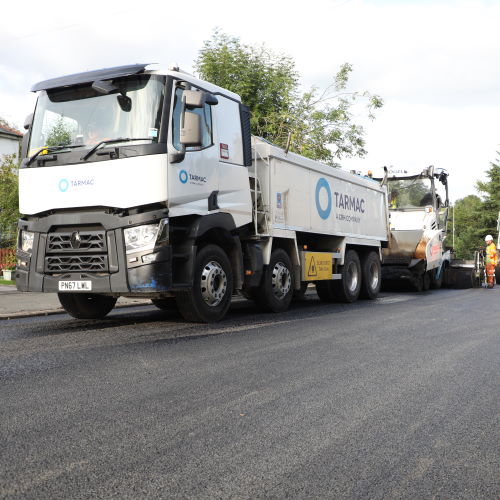
In line with Sheffield City Council’s Climate Action Plan and their commitment to making climate aware decisions, the Council and their delivery partner Amey were keen to explore ways of reducing the net carbon emissions from road maintenance activities. After discussions with Tarmac’s Technical team about alternative materials, ULTILOW warm mix asphalts were proposed for base and binder courses when resurfacing around 14,000 m2 of road on Birley Spa Lane, a busy bus route that runs through a residential area in the southeast of the city. Warm mix asphalts comply with all the traditional hot mix requirements i.e. same bitumen content, same aggregates, same grading targeted, same insitu voids achieved and deliver an equivalent performance to hot materials, but with lower carbon emissions during production.
Our solution
Tarmac’s ULTILOW warm mix asphalts are manufactured and laid at lower temperatures, which results in a typical 8-10% reduction in carbon emissions. They also offer proven gains in productivity, needing less time to reach trafficking temperatures. Using warm mix asphalts in base and binder courses would allow completion of multi-layer paving in a single shift, reducing overall programme times and allowing the road to be opened sooner. This would help to minimise disruption to road users, another key objective for the council. Air quality is also improved for paving teams and residents, since warm mix asphalts are proven to reduce fumes on site by up to 90% and also reduce the risk of burns compared to hot mix asphalts.
Results and benefits
In total 4,893 tons of warm mix asphalt base & binder course were supplied and laid on this scheme as a AC 32mm 40/60 pen HD base and AC 20mm 40/60 pen HD binder. This delivered a saving in carbon emissions of 16.3 tonnes, the equivalent to a family car travelling 100,000 miles. Incorporating approximately 15% reclaimed asphalt planings (RAP) also helped reduce embodied carbon. Using this approach enabled the council to deliver on their commitments to maintain roads and minimise disruption while delivering on their climate change commitments. It also helped to deliver a durable, long term surfacing solution on this busy bus route.
